







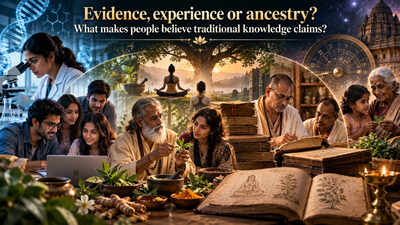


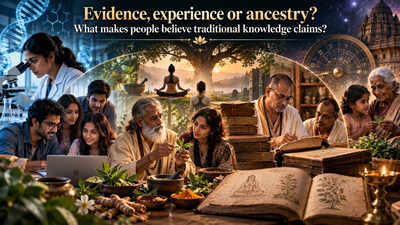
Background: Traditional knowledge derives credibility from multiple epistemic sources, including scientific evidence, practitioner experience, classical texts, and intergenerational transmission. Yet, limited empirical research examines how these epistemic bases shape the perceived credibility of Indian Knowledge Systems (IKS).Objectives: This study examines what makes traditional knowledge credible to different audiences, and whether the basis of that credibility changes with expertise and age.Methods: A multi-domain, within-subject study involved 10,100 participants: 10,000 members of the general public and 100 IKS experts. Claims spanning Ayurveda, Yoga, Jyotisha, and related IKS domains were evaluated through five frames: scientific evidence, practitioner experience, intergenerational transmission, classical textual authority, and combined traditional-scientific evidence. Credibility was measured using an adapted Appelman-Sundar Message Credibility Scale (α=.93; 1–10).Results: Among the public, scientific evidence received the highest credibility (M=9.2), followed by combined evidence (M=8.7), while intergenerational transmission ranked lowest (M=3.2). Differences across frames were significant (p=.001, η²=.14). IKS experts instead rated classical textual authority highest (M=8.8), followed by practitioner experience (M=8.0) and intergenerational transmission (M=7.9). Respondents below 30 favoured scientific evidence (M=9.6), whereas those above 50 favoured classical textual authority (M=8.0).Implications: Traditional knowledge is not judged by a single standard of credibility. The findings expose a generational and expertise-based divide in what counts as valid evidence, suggesting that universal validation models may fail to build trust across different IKS audiences.