







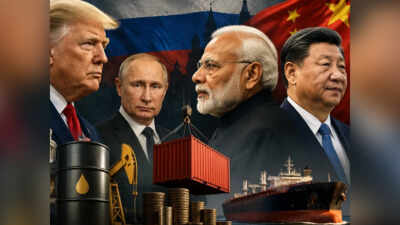


India, Russia and China on Thursday reacted to a sweeping US sanctions bill that gives President Donald Trump the authority to impose tariffs of up to 100 per cent on countries including India and China over purchases of Russian oil and gas.The US House of Representatives passed the Lindsey O. Graham Sanctioning Russia and Iran Act of 2026 by a vote of 262-159 on Wednesday, sending the legislation to Trump for signature.The Senate had approved the bill by 86-11 on August 7.The legislation expands sanctions against Russia and also gives the US president authority to impose steep tariffs on the five largest buyers of Russian petroleum or natural gas.The bill does not itself impose a 100 per cent tariff on Indian or Chinese goods, but creates a pathway for the administration to impose such tariffs under specified conditions.
India says energy security, economic interests remain priority
India said it will take all necessary steps to protect its trade and economic interests and ensure energy security for its 1.4 billion people following the passage of the legislation.The ministry of external affairs (MEA) said India was monitoring further developments following the US House vote and remained “firmly committed” to ensuring the country’s energy security.“As stated on several earlier occasions, India remains firmly committed to ensuring energy security for its 1.4 billion people,” the MEA said.“It will continue to do so through diversified sourcing and on the basis of evolving market dynamics,” it added.The ministry said the issue had been “discussed at high levels in recent months with various US interlocutors” and that India had clearly articulated the potential implications for both the bilateral relationship and the international energy market.The MEA also said India had conveyed its determination to take all necessary measures to protect its trade and economic interests.“The government will work closely with Indian trade and industry bodies to deal with the implications of these developments,” it said.Russia has become a major source of India’s energy requirements in recent years, with Indian purchases of Russian crude rising significantly.A report by the Global Trade Research Initiative (GTRI), said India should continue buying Russian crude as long as it remains commercially competitive and should not compromise its energy security for temporary tariff relief from Washington.India imports more than 88 per cent of its crude oil requirements, according to the GTRI report.In July 2026, India imported $7.27 billion worth of crude from Russia out of total crude imports of $14.21 billion. Russia accounted for a larger share than the UAE, Saudi Arabia, Venezuela, Brazil, Oman and the US individually.The GTRI said India’s crude sourcing pattern had changed sharply since 2022. Before then, Gulf countries accounted for more than 55 per cent of India’s crude supplies, while Russia’s share was below 15 per cent. The report said the Gulf share had since fallen below 30 per cent, with India sourcing larger quantities from Russia.“India should not allow US tariff threats to determine its energy policy,” the GTRI said, adding that India should continue buying Russian oil as long as it remained commercially competitive and negotiate with Washington without granting unilateral trade concessions.The report also said the actual impact on Indian exports could only be assessed once the US announces the tariff rates, product coverage and implementation timetable.
Russia says sanctions could complicate Ukraine peace efforts
Russia criticised the new US sanctions package, saying further measures against Moscow could make efforts to reach a peace settlement in Ukraine more difficult.Kremlin spokesman Dmitry Peskov said Russia was monitoring the legislation and described additional US sanctions as “unfriendly actions”.“We are, of course, monitoring the progress of this document. It falls under the category of unfriendly actions, and of course the imposition of any additional sanctions by the US would certainly complicate efforts to find a peace settlement in Ukraine,” Peskov told reporters, according to Reuters.The sanctions package targets Russia’s energy and defence industries, Russian officials and financial institutions, as well as vessels forming part of what Washington describes as the country’s “shadow fleet” of tankers used to maintain energy shipments despite existing Western restrictions.The legislation is aimed at increasing economic pressure on Moscow over its war in Ukraine, which has entered its fifth year.US-mediated efforts to end the war have been stalled for months. Trump sent two envoys to Moscow and Kyiv earlier this month as part of efforts to restart the peace process.
China rejects US ‘long-arm jurisdiction’
China also rejected the US move to use tariffs against countries buying Russian energy, saying its normal trade and economic cooperation with other countries should not be subject to interference or coercion by third parties.Chinese foreign ministry spokesperson Guo Jiakun said Beijing opposed what he described as US “long-arm jurisdiction”.“China consistently opposes long-arm jurisdiction that lacks a basis in international law and is not authorised by the United Nations Security Council,” Guo said at a media briefing.He said China had always conducted normal economic and trade cooperation with countries around the world on the basis of equality and mutual benefit.“Such cooperation neither targets any third party nor is subject to interference or coercion from any third party,” Guo said.China has repeatedly opposed unilateral sanctions and has continued to purchase oil from countries including Iran despite US sanctions.China and India are among the largest buyers of Russian oil and gas. Much of China’s Russian energy imports are transported through pipelines crossing the countries’ land border.According to official data, China’s imports of Russian oil and gas amounted to $64 billion last year, while imports from January to August this year crossed $70 billion.
What the US bill seeks to do
The Lindsey O. Graham Sanctioning Russia and Iran Act of 2026 was developed after more than a year of negotiations and expands sanctions targeting Russian officials, financial institutions and banking authorities.It also targets Russia’s “shadow fleet” of vessels that Washington says helps Moscow evade existing sanctions on oil deliveries.A key provision gives Trump authority to impose tariffs of up to 100 per cent on the five largest importers of Russian petroleum or natural gas.The legislation provides an exemption for countries importing less than 15 per cent of Russian natural gas exports that have taken substantial steps to reduce those purchases.The bill also creates a statutory pathway for tariffs of up to 100 per cent on imports from India if specified conditions concerning Russian energy purchases are met.The legislation incorporates Trump’s demand for a five-year extension of existing sanctions on Iran.With House passage secured, the bill now goes to Trump for his signature. If enacted, it would give the administration expanded sanctions and tariff authorities aimed at increasing economic pressure on Russia and countries that continue significant trade in Russian energy.