

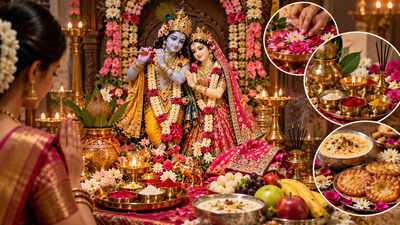








Every year, one question quietly comes up between Janmashtami and Radha Ashtami.Why does Radha Ashtami come around 15 days after Krishna Janmashtami? Is there any deeper meaning behind this gap?The first answer comes from the lunar calendar.Krishna Janmashtami is observed on Krishna Paksha Ashtami, the eighth tithi of the waning phase of the Moon. Radha Ashtami is observed on Shukla Paksha Ashtami, the eighth tithi of the waxing phase.So, essentially, Krishna appears on one Ashtami and Radha is celebrated on the next Ashtami after Amavasya.That naturally creates a distance of approximately 15 tithis between the two festivals.In 2026, Krishna Janmashtami was observed on September 4, while Radha Ashtami falls on September 19.But there is an important technical point here.
It Is 15 Tithis, Not Necessarily Exactly 15 Solar Days
A tithi is not the same thing as a 24-hour calendar day.Tithi is calculated from the angular distance between the Sun and Moon. Because the Moon does not move at exactly the same speed every day, a tithi can be shorter or longer than 24 hours.This is why Hindu festivals sometimes appear to shift by a day when compared with the Gregorian calendar.So when we casually say that Radha Ashtami comes “15 days after Janmashtami”, technically it is better understood as the corresponding Ashtami of the opposite Paksha.There Is Another Calendar Nuance Most People MissDepending upon whether one follows the Purnimanta or Amanta lunar calendar, the name of the lunar month associated with Janmashtami can also differ.In the Purnimanta tradition, Krishna Janmashtami is described as Bhadrapada Krishna Ashtami, while in the Amanta system it falls during Shravana Krishna Ashtami.Radha Ashtami, however, is observed on Bhadrapada Shukla Ashtami.This distinction matters because we often try to understand Hindu festivals through Gregorian dates alone, while the traditional calendar is working through a much more layered combination of Paksha, Tithi, Nakshatra and lunar month.And Then Comes the Spiritual InterpretationThe calendar explains when Radha Ashtami comes.Bhakti explains why the sequence feels so meaningful.Janmashtami celebrates the appearance of Shri Krishna.Then comes Amavasya, the darkest phase of the lunar cycle.From there, the Moon begins increasing again. Tithi by tithi, light returns until we arrive at Shukla Ashtami and celebrate Radha Rani.I find this sequence deeply symbolic.Krishna comes first. Radha teaches us how to reach Krishna.Krishna can be understood as consciousness, wisdom and divine presence. Radha represents prem, bhakti and samarpan, the love through which that divine presence becomes personal.This should be understood as a devotional interpretation, rather than as a claim that the lunar gap itself was scripturally designed to communicate this symbolism.Still, the sequence is beautiful.Janmashtami gives us Krishna.Radha Ashtami, fifteen tithis later, asks a more personal question:Now that Krishna has entered your life, do you have the love, surrender and devotion required to experience Him?Perhaps this is also why celebrating Janmashtami alone can feel like knowing Krishna’s story, while Radha Ashtami takes us closer to understanding Krishna bhakti.One celebrates the Divine.The other celebrates the love for the Divine.And somewhere between these two Ashtamis lies the entire philosophy of Radha and Krishna.