







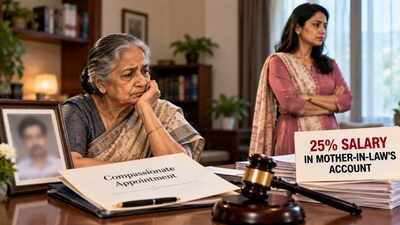


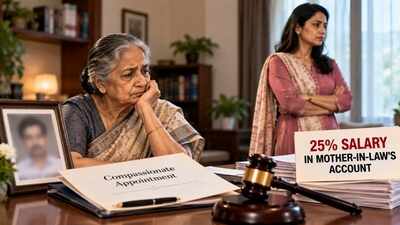
It is a known practise for government jobs to be offered to the family of the deceased if the employee has passed away while still in service. The aim of this practise is to ensure that the bereaved family has access to a stable and regular source of income following the government employee’s death.However, in one such case, a widow secured a government job under this provision but later allegedly left her late husband’s parents on their own, remarried and moved out of the matrimonial home. The Rajasthan High Court has now ruled that she should pay a certain percentage of her salary to in-laws.
What the case is about
A man, who was employed with Ajmer Vidyut Vitran Nigam, died in 2017. Following his death, the company informed his family that government rules permitted one eligible family member to receive employment on compassionate grounds.After discussions among the family members, it was agreed that his wife would take up the appointment. Her mother-in-law and father-in-law consented to this arrangement on the understanding that she would take responsibility for their care after joining the government job.However, according to the court case filed against her, she did not fulfil that expectation. Instead, she left her in-laws allegedly without support and remarried, prompting her mother-in-law to approach the court.
Why did the mother-in-law win the case?
The Rajasthan High Court explained that a compassionate appointment is intended to provide monetary support to a family struggling to cope with the sudden death of its sole earning member. The purpose is to help the family overcome the immediate financial difficulties arising from the loss.The court clarified that the family covered under the scheme is not restricted to the deceased employee’s widow. It also extends to his parents and other relatives recognised under the applicable rules.In the present matter, the man’s widow had furnished an affidavit at the time of seeking compassionate employment, undertaking to take care of the other members of the family.But after securing the job, she allegedly left her in-laws to deal with financial hardship and other difficulties on their own. She moved out of the matrimonial home and subsequently married another person, according to an ET report.The Rajasthan High Court observed: “Having availed the benefit of compassionate appointment after giving aforesaid undertaking, she cannot completely disassociate herself from the obligation, which formed the very basis of the compassionate appointment.”The Court held that her decision to leave the matrimonial home and remarry, along with her admitted failure to provide maintenance to her in-laws, amounted to a clear departure from the basic objective of the compassionate appointment scheme.The Rajasthan High Court said: “It cannot be countenanced that, after the death of her husband, the daughter in law, having secured a compassionate appointment in his place, may thereafter abandon her aged in-laws and leave them at the mercy of destiny.”The court also referred to the judgment in Bhagwan Singh Vs. Suptd Engineer Pawas, Ajmer Vidhut Vitran Nigam Limited, reported in 2025 LiveLaw (Raj) 364.
- Taking these observations into account, the Rajasthan High Court directed Ajmer Vidyut Vitran Nigam Limited to deduct 25% from the widow’s regular monthly salary and transfer that amount directly to her mother-in-law’s bank account.
- It further ordered that the deceased employee’s terminal benefits be distributed equally, with 50% going to the widow and the remaining 50% to his mother.
Advocate Amitraj Kaushal, who practises in the Supreme Court of India, told ET that the Rajasthan High Court’s ruling rested mainly on the commitment made by the widow when she applied for compassionate employment and the underlying objective of the scheme.The Court took note of her undertaking to provide maintenance to the other members of her late husband’s family, including his parents. Despite securing the appointment, she subsequently moved out of the matrimonial home, discontinued support for her in-laws and remarried.Kaushal said the court held that she could not accept the advantage of compassionate appointment on the strength of that commitment and then entirely walk away from the responsibility attached to it. The court also underscored that the scheme exists to provide financial assistance to the deceased employee’s family as a whole, rather than serve as an individual benefit for the widow alone.