







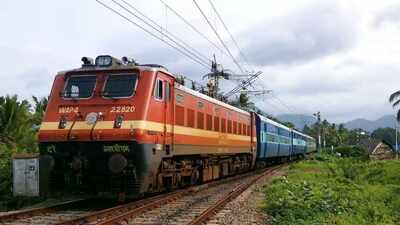


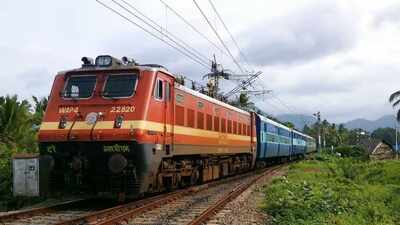
Indian Railways seems to be running short of locomotives to run its passenger trains, prompting the national transporter to make use of locos for freight trains. A shortage of locomotives meant for passenger services has forced Indian Railways to deploy slower freight engines on passenger trains, resulting in delays running into several hours, according to railway records.The Railway Ministry, however, said it was accelerating efforts to expand locomotive production. It has approved 492 passenger locomotives for 2026-27 and another 187 for 2027-28, taking the total to 679 over the two financial years.“The 2026-27 programme includes 326 WAP-7 locomotives and 166 WAP-7 locos. Besides these productions in the pipeline, there is a rapid adoption of modern trainsets and improvement in utilisation of existing assets,” a senior official from the Ministry told PTI.The official added that train operations had expanded manifold over the past 12 years, and Indian Railways was making every effort to provide a safe and comfortable journey to passengers across all categories.Also Read | Delhi-Varanasi in less than 4 hours, Mumbai-Pune in 48 minutes, Chennai-Bengaluru in over 1 hour: Indian Railways bets on seven new bullet train corridors in Rs 16 lakh crore high-speed push
Delays of several hours
Railway records quoted in the PTI report contain several instances in which a lack of locomotives designed for passenger services led to trains being hauled by freight engines, which operate at lower speeds. The use of these locomotives has affected running times and caused operational delays, the records show.Officials confirmed that railway zones across the country report an average of 80 to 100 such incidents every month.One recent case involved Train No. 11044, the Ballia-Dadar Central Express, whose operations were disrupted on September 3, 2026, for 5 hours and 28 minutes because the required passenger locomotive was unavailable, according to railway records.The train was scheduled to operate with a WAP-4 passenger locomotive, capable of running at speeds exceeding 130 kmph. However, North Eastern Railway arranged a freight locomotive certified for speeds of up to 100 kmph because a suitable passenger engine was not available.“The train subsequently suffered loss on run in the Bina–Khandwa section between 13:26 hrs and 00:59 hrs. The incident resulted in a recorded detention of 328 minutes (5 hours 28 minutes),” sources told PTI.Also Read | Second Vande Bharat sleeper set to launch this month between Bengaluru and Mumbai; cutting travel time from 24 hours to under 16 hours, 30 year wait for faster connectivity between two cities to end
Indian Railways’ locomotives fleet
Data for September 2026 show that Indian Railways has approximately 17,900 locomotives in its fleet. Of these, around 13,700 are electric engines, while roughly 4,200 run on diesel.Of the approximately 13,700 electric locomotives in Indian Railways’ fleet, around 3,400 are passenger engines belonging to different variants of the broad-gauge AC electric WAP series. The remaining locomotives are from the WAG series, designed primarily for freight services and associated operational requirements.Among the 4,200 diesel locomotives, 284 are deployed for passenger services. Most of the others are used for freight transportation, shunting, departmental work and other duties.Indian Railways data show that its locomotive fleet comprised 10,456 engines in 2013-14, including 5,633 diesel and 4,823 electric locomotives. Of the electric engines, 1,371 were passenger locomotives. However, the data for that financial year do not specify the total number of diesel locomotives used for passenger services.Railway officials said the expansion of electrification from 2014 onwards gradually slowed diesel locomotive production, while manufacturing of electric engines gathered pace.Instances of freight locomotives being deployed on passenger trains have been reported across almost every railway zone in the country.On September 21, 2026, records showed that at least two passenger trains were operating with WAG-9 freight locomotives, which have a maximum running capacity of 100 kmph. The substitution was necessary because passenger locomotives capable of running at higher speeds were unavailable.In one such case, Train No. 14102, the Kanpur Central-Prayagraj Sangam InterCity Express, was assigned a WAG-9 freight locomotive with a running capacity of 100 kmph.According to sources, the train was scheduled to run with a WAP-1 passenger locomotive, which can operate at speeds of up to 130 kmph.“Due to shortage of passenger locomotives, the rail administration has to substitute it with freight engines. This led to a delay of at least 30 minutes as the train operated at 100 kmph in sections where the speed permission was 130,” a railway source said.A second incident recorded on the same day highlighted similar operational difficulties arising from the use of freight engines on passenger services.Train No. 17601, which operates between Kacheguda in Telangana and Shri Ganganagar in Rajasthan, was assigned a WAG-9 freight locomotive instead of its scheduled WAP-7 passenger engine because of a shortage. The substitution resulted in a detention and affected the train’s overall punctuality.“The production of locomotives has increased manifold in the last 12 years. However, years of neglect of several crucial manufacturing activities before 2014, which caused a severe shortage of locomotives, wagons and coaches, will be compensated in due course of time,” a senior zonal railway official said.