











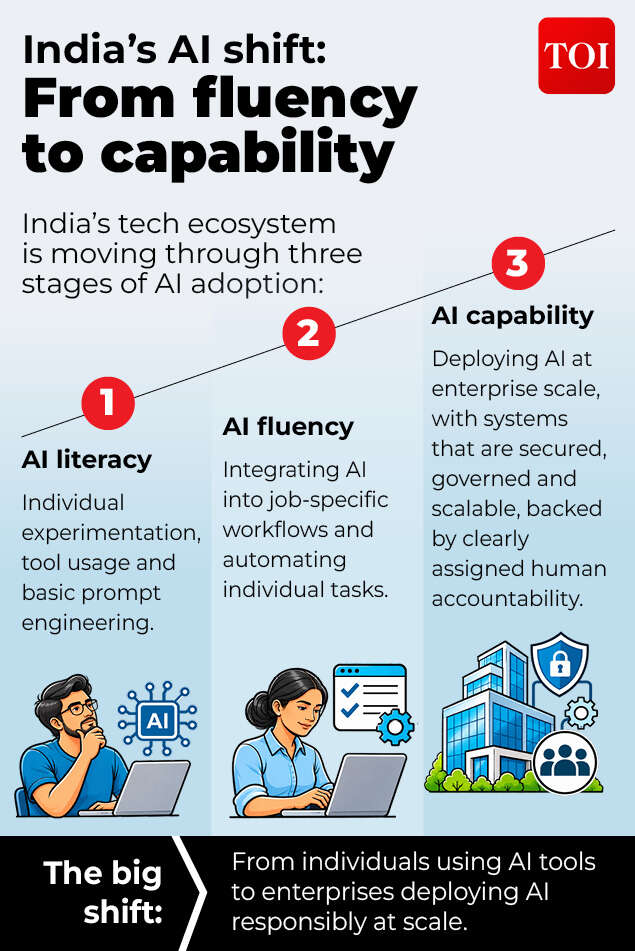
By Neeti Sharma, CEO, TeamLease DigitalThe contemporary enterprise operates in an environment defined by unprecedented geopolitical volatility, economic shifts, and rapid technological acceleration. Across the Asia-Pacific region, 81% of senior leaders identify the capacity to operate effectively amid constant change and uncertainty as an indispensable leadership requirement. Against this backdrop, artificial intelligence is shifting from a technological initiative to the core operating model.India’s tech ecosystem is undergoing a structural transition: the shift from AI Fluency to AI Capability.
- The Literacy Stage: Individual experimentation, tool usage, and basic prompt engineering.
- The Fluency Stage: Integration of AI into role-specific workflows and task-level automation.
- The Capability Stage: Enterprise-grade production where AI systems are deployed, secured, governed, and scaled with named human accountability.
While 81% of APAC midmarket enterprises have embedded AI into daily operations, only 27% report that their leaders are fully prepared to integrate AI-generated insights, exercise critical judgment, and manage compound risk. As execution costs collapse toward zero, compensation and enterprise value are decoupling from traditional job titles and tenure. Instead, value is concentrating at the intersection of technical depth, domain context, and human judgment.
The Re-Pricing of Digital Talent
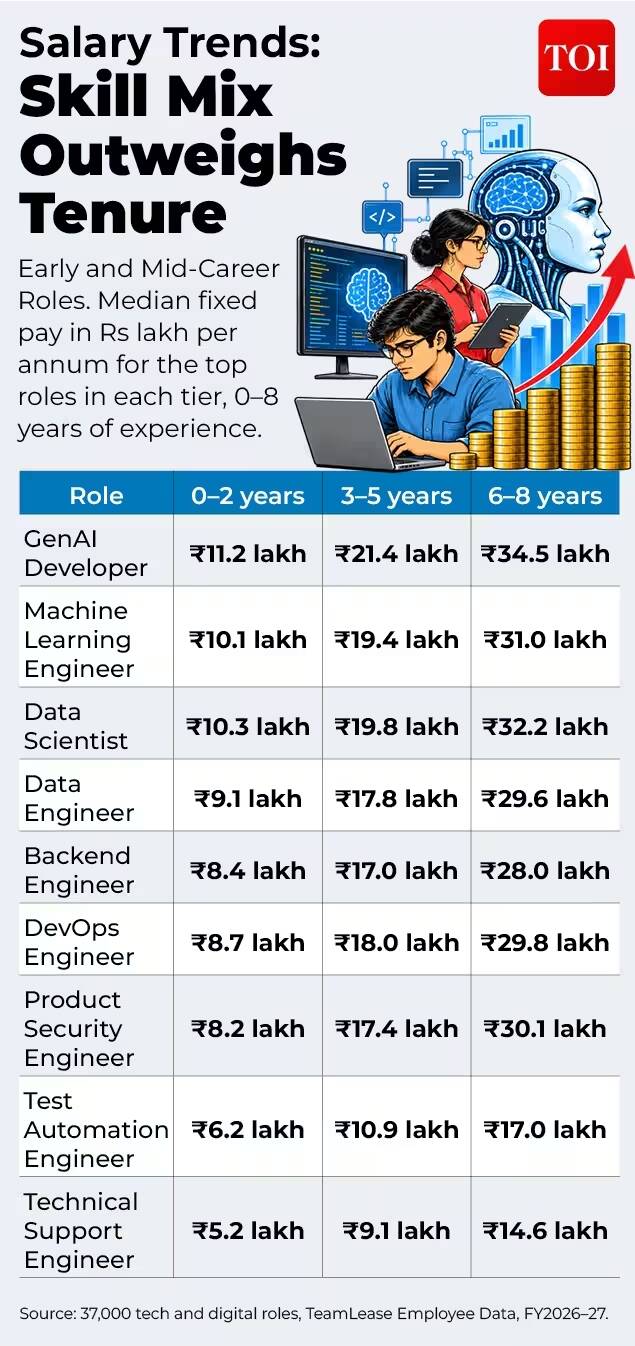
An analysis of over 37,000 technology and digital roles shows that traditional valuation proxies—such as headcount, geographic tier, and years of service- no longer accurately predict market value.Consider a stark market anomaly: a GenAI engineer in Indore commands a median fixed salary of Rs 16.5 LPA, out-earning a cybersecurity engineer in Bengaluru at Rs 14.4 LPA. Skill tier and capability proximity now supersede location and legacy tenure.
Three stages of AI adoption
Enterprise Talent Tiering Model
- AI-Core Tier: Roles that build, own, and govern intelligent systems open at Rs 13.2 LPA for early-career roles, with projected annual growth of 16% to 21%. Compensation scales at 2.5x to 3.0x baseline levels.
- AI-Adjacent Tier: Roles that apply AI in core workflows command mid-tier premiums.
- AI-Support Tier: Roles focused on routine monitoring, data QA, and first-line maintenance open between Rs 4.8 and 5.4 LPA, growing at a modest 7% to 8%.
The resulting 2.5x to 3.0x entry pay differential compounds over time. This divergence represents a structural scarcity premium. Only 16% of India’s technology workforce currently possesses advanced AI capabilities, against an enterprise talent deficit of 53% to 60% in GenAI and cloud architectures.Prompting and basic tool usage have quickly become table stakes. The durable premium accrues to professionals who can bridge technical execution with risk oversight, domain nuance, and business accountability.
The Verification Bottleneck and Executive Oversight
As AI models handle increasingly sophisticated analytical and generative tasks, organizations face a subtle operational risk: equating polished analysis with sound judgment.Generative tools can produce well-formatted code, market assessments, or legal summaries that look authoritative while masking flawed assumptions or outdated regulatory inputs. While AI expands the volume of intelligence, it cannot verify its own contextual accuracy.This dynamic creates an operational bottleneck. Enterprise survey data indicates that 66% of organizations struggle with stakeholder trust issues related to AI output, data privacy, and ethical compliance. Furthermore, only 15% of APAC CEOs report achieving both revenue expansion and cost reduction from their AI investments, with half seeing neither benefit yet.The bottleneck is rarely the technology itself; it is the organizational capacity to evaluate, govern, and operationalize model outputs. Senior leadership must shift focus from acquiring pure execution capacity to developing Architects of Inquiry, leaders who use domain expertise not to supply canned answers, but to ask the critical questions that surface hidden assumptions, missing evidence, and edge-case risks.
The Enterprise Governance Blueprint for Human-in-the-Loop Operations
To successfully balance AI adoption with operational integrity, organizations require a repeatable operational framework. “Human-in-the-loop” cannot remain a vague supervisory concept; it must be operationalized across four key pillars:
- Strategic Framing: Before deploying models, human leads must define the business problem, operational boundaries, regulatory constraints, and acceptable error tolerances. Without explicit framing, AI systems risk optimizing for the wrong objectives.
- Rigorous Challenge: Outputs must be subjected to systemic stress-testing. Leaders must cultivate a culture that asks: What assumptions underly this result? What data was omitted? Where does this model fail in edge cases?
- Named Accountability: Every automated workflow reaching production must have a named human owner who accepts legal, financial, and operational responsibility for its outcomes.
- A Cloud Security Architect lets AI automate threat triage, but retains ownership over breach containment decisions.
- A Data Architect uses automated pipelines, but owns the ultimate integrity and regulatory compliance of the data estate.
- Deterministic Escalation: Organizations must institute explicit protocols defining when an AI system must yield to human judgment. Workflows containing high legal, reputational, or financial risk require mandatory human sign-off.
This framework applies equally across functional areas. In finance, marketing, HR, and supply chain operations, AI handles preliminary synthesis, shifting human effort toward trade-off evaluation, strategic alignment, and stakeholder trust.
Skill Mix Outweighs Tenure
Senior compensation ceilings illustrate this shift. At 15+ years of experience, compensation is set by enterprise trust, governance, and architecture scale rather than raw code volume:
- AI Architect: Rs 108.6 LPA
- Industrial Data Architect: Rs 102.6 LPA
- OT Security Architect: Rs 95.8 LPA
Workforce Vulnerability and the Early-Career Capability Pipeline
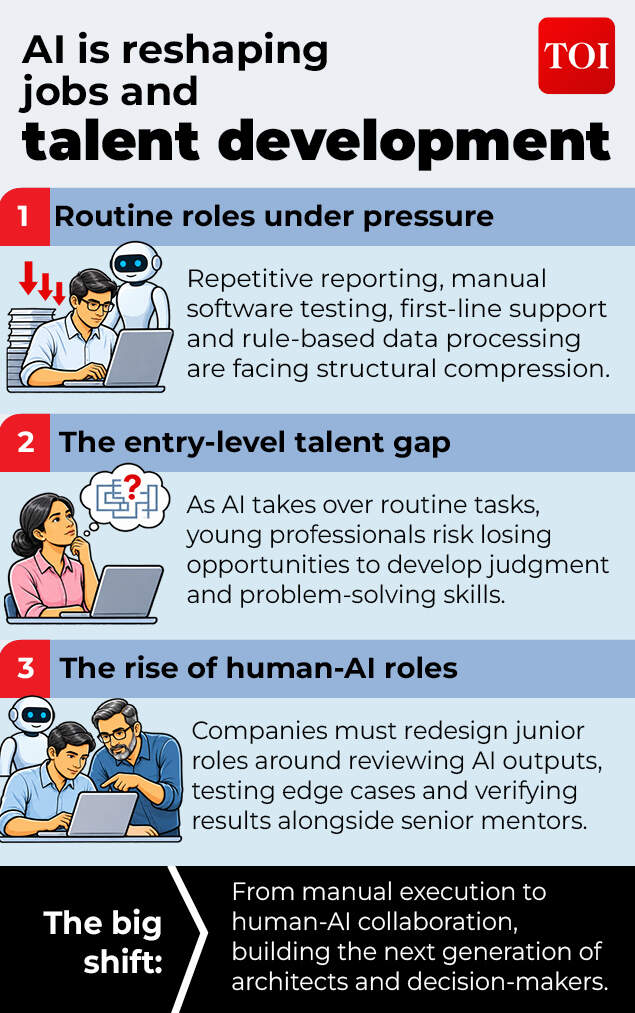
The transition toward AI-driven execution exposes a sharp divide in the talent market. Routine execution roles, such as repetitive reporting, manual software testing, first-line support, and rule-based data processing, are undergoing structural compression. Across GCCs and enterprise technology providers, zero AI-Support roles feature among high-growth premium categories.Task automation presents a systemic challenge for talent development: the erosion of the entry-level learning pipeline. Historically, professionals developed judgment by working through routine, task-level problems. If AI platforms absorb these baseline responsibilities, enterprises risk interrupting the natural development pipeline required to cultivate future architects and decision-makers.Organizations must re-architect entry-level roles. Instead of assigning junior staff to manual execution, companies should integrate early-career talent directly into human-AI “fusion roles”. In these roles, junior staff learn by reviewing AI-generated outputs, evaluating edge cases alongside senior mentors, and participating directly in verification workflows.
AI is reshaping jobs and talent development
Executive Strategies for Workforce Adaptation
To navigate the shift from AI adoption to govern enterprise capability, leadership should prioritize three strategic imperatives:1. Transition from Experimental Pilots to Governed ProductionProof-of-concept projects rarely generate durable enterprise value or capability depth. Organizational resources must focus on embedding AI inside live operational workflows backed by explicit governance mechanisms. Capability development should move talent systematically through structured pathways: from experimental sandboxes to manager-nominated production deployments and formal model evaluation roles.2. Drive Lateral Capability Reskilling Across Adjacent TracksBecause off-the-shelf senior talent is scarce, enterprise agility depends on internal mobility and reskilling. The most cost-effective path to building capacity is moving experienced domain professionals into adjacent, high-demand technical tracks:
- Test Automation Engineers transitioning into Quality & Platform Operations
- Business Analysts evolving into Decision Intelligence & Data Product Management
- Infrastructure Engineers pivoting to Cloud Security & GRC Governance
Moving professionals into higher-value capability tracks yields significant productivity returns compared to static internal progression. Combining deep domain knowledge with AI capability creates talent that is difficult to replace.3. Institutionalize Critical Inquiry as an Enterprise DisciplineOrganizations should establish formal operational routines that reward critical thinking and structured skepticism. Enterprise initiatives should include:
- Scenario & Stress-Testing Drills: Pairing technical engineers with domain leads to stress-test model outputs under simulated failure conditions.
- Portfolio & Verification Standards: Evaluating talent based on tangible deployment outcomes, architectural contributions, and documented governance decisions rather than abstract tool certifications.
Technology cycles will continue to accelerate, rendering specific toolsets obsolete. What remains durable is the enterprise capacity to govern complex systems, make reasoned trade-offs under uncertainty, and maintain institutional trust.Enterprise readiness is ultimately measured not by total headcount or the sheer volume of AI deployment, but by capability depth and decision quality. In an AI-augmented economy, competitive advantage belongs to the organizations and leaders, those who balance fast technological execution with rigorous, accountable judgment.(The author is CEO, TeamLease Digital)