







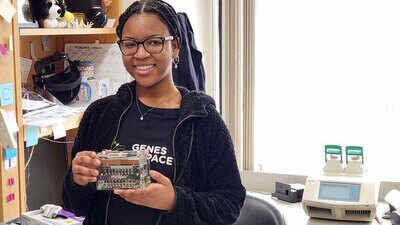


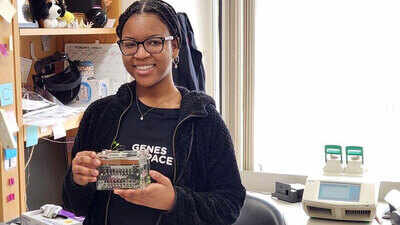
Most school science projects are presented in classrooms, evaluated by teachers and eventually packed away. Pristine Onuoha’s project took a rather different route. It travelled aboard a spacecraft to the International Space Station, where astronauts helped test the idea.Onuoha was still in high school when she began working on a scientific question that has interested researchers studying human spaceflight: how can scientists monitor changes in DNA when astronauts are living and working in space?Her proposal won the 2022 Genes in Space competition. The experiment was subsequently launched to the International Space Station in June 2023. Now, her journey has reached another milestone. A research paper listing Onuoha as its lead author was published in July 2026.For a student who began with a science competition entry, it is an extraordinary journey.
The question behind the experiment
One of the interesting biological changes observed during spaceflight involves telomeres. These are protective structures found at the ends of chromosomes, which carry genetic information inside cells.Earlier research had suggested that astronauts’ telomeres could become longer during spaceflight. Understanding changes in these structures is important because telomeres are associated with cellular ageing and chromosome stability.But studying DNA aboard a spacecraft is not as straightforward as doing it in a well-equipped laboratory on Earth.Researchers need methods that are compact, reliable and suitable for use in the restricted environment of a space station.This was the challenge that Onuoha’s project sought to address.
Taking DNA testing into space
The research focused on a technique called fluoPCR, which combines DNA amplification with fluorescence-based detection.In simple terms, the method makes multiple copies of selected DNA sequences and uses fluorescent signals to help measure the results.The advantage is that the technique can work with relatively compact equipment, making it potentially useful in environments where conventional laboratory facilities are unavailable.During the International Space Station experiment, researchers tested DNA sequences of different lengths. The technique successfully detected targeted sequences of 100 and 400 base pairs, with results consistent with conventional laboratory measurements.A longer 1,600-base-pair sequence, however, was outside the method’s informative detection range.The findings were reported in a peer-reviewed paper titled Validation of a fluorescence-based method for the quantitative detection of specific nucleic acids aboard the ISS, published on July 18, 2026.There is an important distinction here. The research did not establish why astronauts’ telomeres change during spaceflight. Its contribution was to validate a method for detecting and measuring specific DNA sequences in the space environment.
From a teenager’s idea to published research
Onuoha’s achievement is particularly encouraging because she did not simply win a competition and move on to another project. Her original research idea became part of a larger scientific effort involving researchers and the space station.Her experience also highlights the value of programmes that give school students access to real scientific problems.For young people interested in biology, genetics or space research, her journey offers a glimpse of what can happen when curiosity is supported by good mentorship and opportunities to experiment.A question asked by a high-school student eventually became a research project conducted hundreds of kilometres above Earth.And perhaps that is the most interesting part of her story. The distance between a school classroom and a space laboratory may seem enormous, but for Onuoha, it began with the willingness to ask a scientific question and pursue an answer.