
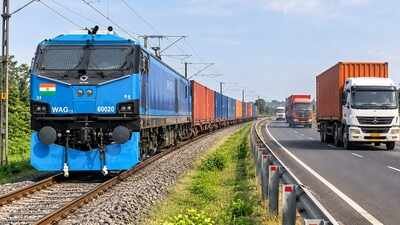






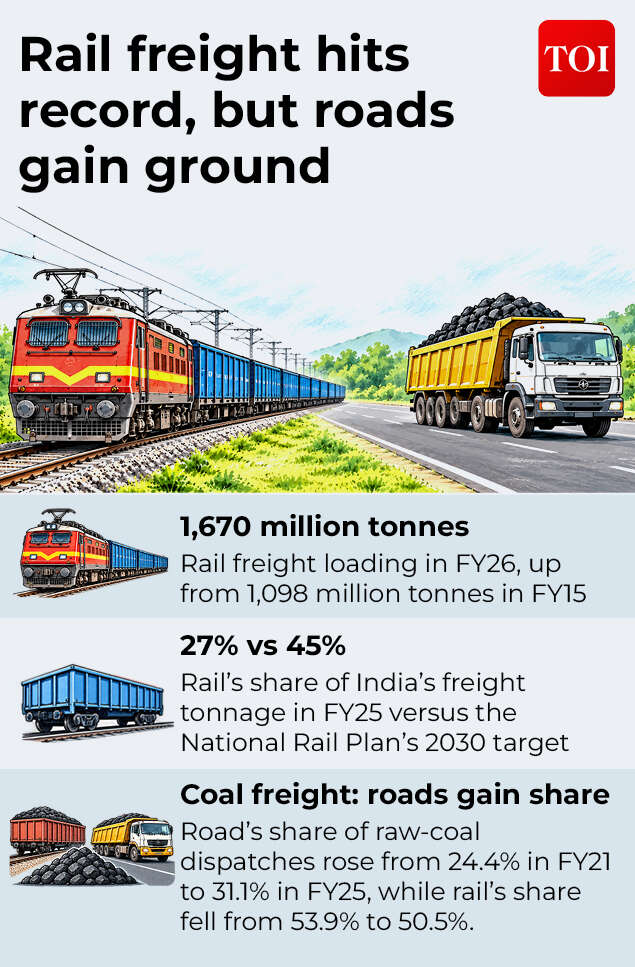
By Jagannarayan PadmanabhanIndian Railways is entering a new phase in freight transportation.The eastern and western dedicated freight corridors (DFCs) are now fully operational, unlocking capacity and enabling faster, more reliable freight movement. More capacity is on the horizon, with a proposed east-west corridor set to strengthen connectivity across the country.After decades of investment constraints, rail freight finally has the infrastructure to compete. But infrastructure alone will not win back traffic from roads.The challenge is no longer building tracks. It is persuading customers to choose rail over trucks.At first glance, rail freight appears to be thriving. Freight loading has risen from 1,098 million tonne in fiscal 2015 to 1,617 million tonne in fiscal 2025 and a record 1,670 million tonne last fiscal. Yet rail’s position within India’s logistics system remains weaker than these numbers imply.A parliamentary committee recently estimated rail’s share of national freight tonnage at only about 27% in fiscal 2025, well below the National Rail Plan’s goal of 45% by 2030.The issue is not a shortage of freight. India’s economy generates more than enough cargo to support that ambition. The problem is that roads are increasingly serving customers better.The competitive pressure is visible even in commodities that have traditionally been rail strongholds. Coal, iron ore, steel and cement remain the backbone of railway freight earnings, with coal alone contributing nearly half of freight revenue. Yet roads have steadily expanded their presence across several of these segments.
What Indian Railways must do to win freight back
Coal offers the clearest example. Road’s share of raw-coal dispatches increased from 24.4% in fiscal 2021 to 33.8% in fiscal 2024 before easing slightly to 31.1% in fiscal 2025.Over the same period, rail’s share fell from 53.9% to 47.4% before recovering to 50.5%. Rail may have regained some ground, but roads are now firmly established even in one of its most important freight categories.A similar story emerges elsewhere. Railways moved about 178 million tonne of iron ore in fiscal 2025 against production of roughly 289 million tonne, implying a rail transportation coefficient of just over 60%. Comparable ratios were materially lower for steel and cement. While these figures do not directly measure modal share, they underscore a broader point: a substantial portion of India’s bulk freight still moves outside the rail network.The reasons extend far beyond pricing.India’s freight geography is changing. Urbanisation, rising incomes and e-commerce are shifting consumption away from a handful of metropolitan centres towards hundreds of Tier II and III cities. India’s urban population is estimated to have reached 522 million in 2025 and is projected to approach 600 million by 2036.More revealing is where demand growth is occurring. Tier II and III cities are estimated to have generated around two-thirds of incremental direct-to-consumer orders last fiscal. Warehousing, distribution and industrial activity are following the same trajectory, creating a logistics network that is increasingly dispersed.Road transport has adapted quickly to this reality. Supported by a national highway network that has expanded nearly 60%, from 91,287 km in 2014 to 146,204 km by March 2025, trucks can reach new warehouses, distributors, factories and construction sites directly. They offer flexibility, minimal handling and a single point of accountability from origin to destination.Rail, by contrast, remains primarily a line-haul business.Its challenge is not its dependence on trucks for first-mile and last-mile connectivity. Every major freight system relies on multimodal logistics. The problem is that the transition between rail and road often remains fragmented, creating additional handling, delays and uncertainty for customers.
Rail freight hits record, but roads gain ground
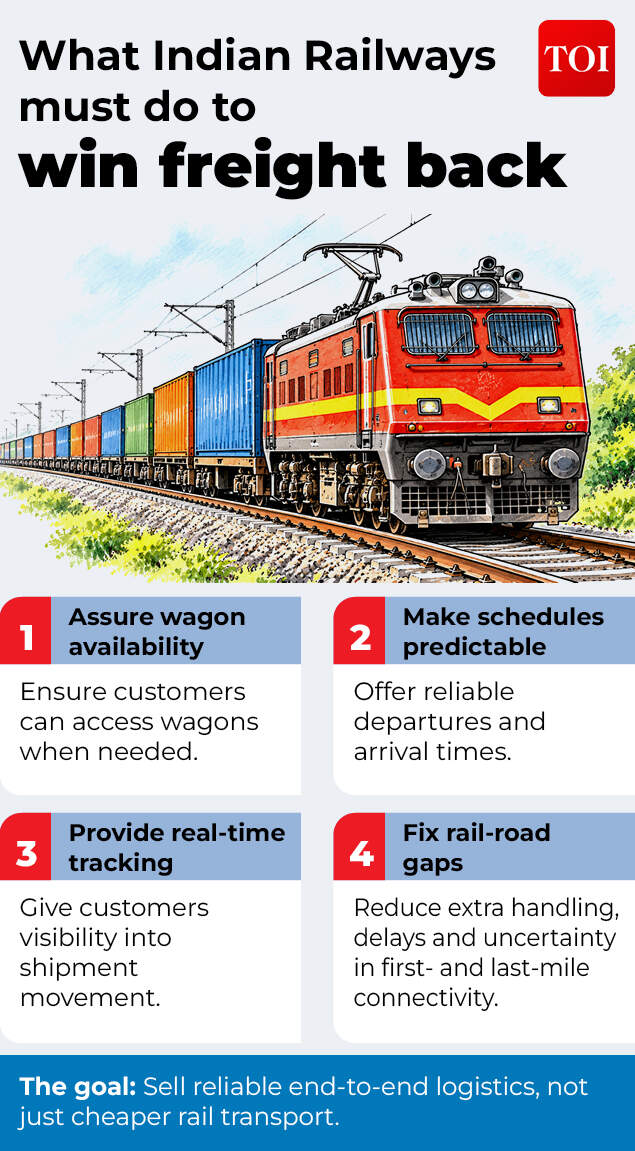
A cement producer or steel manufacturer does not evaluate only the railway tariff. It evaluates the cost, speed and reliability of the entire journey. A lower rail rate becomes irrelevant if cargo must be handled multiple times, delivery windows are uncertain or information is unavailable. Customers buy logistics outcomes, not transport modes.That is why the next frontier for Indian Railways is service quality.The DFCs will improve transit times, but faster line-haul movement is only part of the solution. Customers also need assured wagon availability, predictable departures, reliable arrival schedules and real-time shipment visibility. A steel plant cannot afford disruptions in raw-material supplies because wagons are delayed. An exporter cannot risk missing a vessel because cargo reaches the port late.Railways should therefore measure success not only through loading volumes and freight revenue but also through customer-centric metrics such as on-time arrivals, terminal turnaround times, schedule adherence and customer retention.Reliability must become a product.The same customer-first approach should guide the next phase of cargo-terminal development.The Gati Shakti Cargo Terminal programme has already expanded freight-handling capacity. The next step is to transform these facilities into integrated logistics hubs where cargo can be consolidated, stored, containerised and transferred seamlessly between rail and road.Success will depend less on the number of terminals built and more on where they are located and how effectively they connect with surrounding logistics networks. Facilities should emerge where manufacturing, warehousing and consumption are growing, not simply where railway land is available.Partnerships will be equally important. Railways need not extend tracks to every customer. Instead, it should work more closely with trucking companies, warehouse operators and third-party logistics providers to create integrated door-to-door solutions. Digital platforms offering unified booking, tracking and shipment visibility across modes can further simplify the customer experience.The objective should be simple: make using rail as easy as using a truck.A manufacturer does not necessarily need a private siding, a full rake or even the lowest freight rate. It needs dependable delivery at a predictable total logistics cost. In many cases, the winning solution will not be rail versus road, but rail and road working together.India has largely solved the capacity problem in freight rail. The bigger challenge now is commercial. Roads have gained market share because they have aligned themselves more closely with customers’ needs and adapted faster to the country’s evolving freight geography.The future of freight will not be decided by who can move the most cargo, but who can serve the customer best.Indian Railways has built the infrastructure, now it must build the service model. Only then can it convert freight capacity into freight market share.(The author is Senior Director and Group Head, Consulting, Crisil Intelligence)