









India’s $30-billion pharma industry is staring at a fresh challenge after US President Donald Trump announced that generic medicines imported into the US would face tariffs of 100% from Aug 2028 and 200% a year later, unless companies relocate manufacturing to the US.The announcement has significant implications for India, which supplies nearly 47% of generic prescriptions dispensed in the US, and ships 38% of its pharma exports totalling $10 billion to the American market.While generic medicines remain exempt from tariffs over the next two years, the real challenge begins for domestic companies after two years. Industry experts warn that 100-200% duties could make certain generic exports commercially unviable and squeeze margins. For Americans, tariffs could push up prices of low-cost medicines.
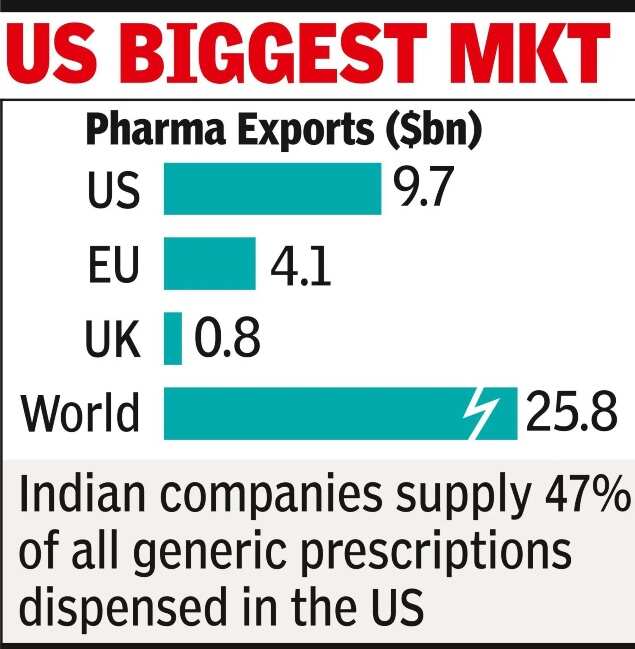
Biggest markets
The two-year window suggests the proposal is being viewed more as a “negotiating lever”, and allows Indian exporters time to recalibrate supply chains and investment strategies. Annaswamy Vaidheesh, a pharma industry veteran, told TOI: “The announcement is more likely a negotiating and onshoring instrument than a practically sustainable tariff policy. Such high tariffs could raise medicine prices and create shortages well before adequate manufacturing capacity is established in the US. Importantly, key starting materials, and pharma ingredients (APIs) are manufactured either in China or India. It will be tough for the US to replicate this ecosystem locally”.Further, there is considerable ambiguity around the actual implementation, but the impact on companies is unlikely to be uniform, analysts said. Certain companies, including Sun Pharma, Dr Reddy’s Labs, Cipla, Lupin, Aurobindo Pharma and Zydus Lifesciences that generate significant revenue ranging from 35% to 50% from the US market, could be hit more.Some of these already have manufacturing facilities in the US, which could partially mitigate the impact, analysts added. Companies are likely to reassess portfolios, gradually moving away from low-margin commodity generics towards complex generics, biosimilars, oncology, and other higher-value therapies.Significantly, generic manufacturing cannot be shifted quickly because it requires technology transfer, regulatory approvals and a supporting supply ecosystem. Dr Reddy’s Labs co-chairman and MD GV Prasad said: “We don’t have any plans yet for manufacturing in US. We are still thinking because even to transfer a product from here to the US, it’s a long regulatory process. You do tech transfer, validation, file, wait for approval. So, two years is very short to do large product transfers. We’ll see how it goes.”Many of the products operate on relatively thin margins and Indian manufacturers cannot absorb such costs. “Even if the burden is shared with US importers, EBITDA margins for US-focused generic companies could decline by around 300-600 basis points”, an industry expert said.The industry will continue to engage with the US administration to build a stronger partnership, said Sudarshan Jain, the secretary general of Indian Pharmaceutical Alliance. India has already started its mitigation plan, according to Pharmexcil chairman Namit Joshi. “Latam market, particularly Brazil, is the fastest growing importing nation for us. Europe is very consistently growing.”