











News Latest

New Recipe

SWAYAM July Semester 2026: NTA extends registration deadline to November 5; direct link to apply here

SWAYAM July Semester 2026 registration deadline extended The National Testing Agency (NTA) has extended the registration deadline for the Study Webs of Active Learning for Young Aspiring Minds (SWAYAM) July 2026 Semester Examination. Candidates who have not yet submitted their application forms can now apply until November 5, 2026.Interested candidates can complete the registration process...

Farah Khan House: Farah Khan gives first glimpse of her seven-bedroom Mumbai home with a private pool and Versova beach views, along with designer bags gifted by Karan Johar | Hindi Movie News

Farah Khan gives first glimpse of her seven-bedroom Mumbai home with a private pool and Versova beach views, along with designer bags gifted by Karan Johar Farah Khan, who has shown viewers inside several celebrity homes in Delhi and Mumbai, has now opened the doors to her own residence for the first time. She also...

Daily Chinese Horoscope, 2nd November: Metal Dragon Day Brings Bold Energy for Monkeys and Rats, While Dogs May Feel Pushed Into Corners at Work

Chinese Horoscope August 31-September 6: These days will test your patience, but Dragon, Snake and Goat could see major obstacles finally clear Everyone, from upper management to your peers, is scheduling meetings and calling for a plan. Under the Chinese zodiac, November 2, 2026, is recognised as Geng Chen Day, a Yang Metal Dragon day....

Manufacturing divide: 10% factories account for 72% output

Table of Content

Lorem Ipsum is simply dummy text of the printing and typesetting industry. Lorem Ipsum has been the industry’s standard dummy text ever since the 1500s, when an unknown printer took a galley of type and scrambled it to make a type specimen book.

The Future of Gadgets

Lorem Ipsum is simply dummy text of the printing and typesetting industry. Lorem Ipsum has been standard dummy text ever since the 1500s,

Lorem Ipsum is simply dummy text of the printing and typesetting industry. Lorem Ipsum has been the industry’s standard dummy text ever since the 1500s, when an unknown printer took a galley of type and scrambled it to make a type specimen book.


Manufacturing divide: 10% factories account for 72% output
Smaller factories dominate India’s manufacturing base but lag sharply in output and productivity.

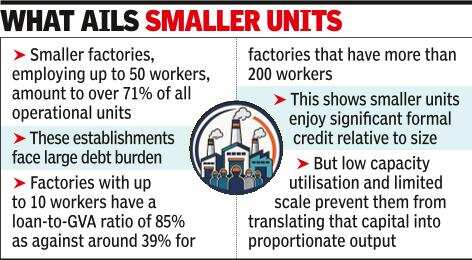
NEW DELHI: India’s manufacturing sector suffers from fragmentation, with a small minority of large establishments driving output, while thousands of medium and small units are burdened with debt and low productivity.Large factories, employing over 200 workers, account for 10.4% of total operational units, but generate nearly 72% of the country’s manufacturing gross value added (GVA) amounting to Rs 15.9 lakh crore and provide 63% of industrial jobs.In contrast, smaller factories, employing up to 50 workers, make up over 71% of all operational units but contribute 10% to overall manufacturing GVA. Units with up to 10 workers represent 36.3% of operational factories, but yield 2% of output, a recent study in a NSO journal, using data from the Annual Survey of Industries (ASI) 2022-23, showed.
Mfg divide

Large factories drive nearly 72% of manufacturing output despite making up just 10.4% of units

The GVA by the manufacturing sector in the country was estimated at around Rs 22 lakh crore in 2022-23. To accelerate industrial growth, policy experts frequently recommend facilitating the scaling up of smaller units through targeted technology upgradation, cluster-based supply chain linkages with larger firms, and easier credit access.This productivity gap also coincides with a large debt burden on smaller establishments as factories with up to 10 workers carry a formal loan-to-GVA ratio of 85%, compared with around 39% for factories that have more than 200 workers. This indicates that while small units leverage significant formal credit relative to their size, low capacity utilisation and limited scale prevent them from translating that capital into proportionate output.In terms of employing women workers, the ASI study underscores much sharper vulnerabilities on factory floors as merely 11% of the overall manufacturing workforce is female. The share rises marginally from 8.5% in factories employing up to 10 workers to 11.5% in large units with more than 200 workers.A key driver behind the productivity divide is the sharp disparity in shop-floor enablers, such as research and development and worker training. Across all operating factories, a mere 2.7% maintain an active R&D unit, while only 6.7% provide formal skill training to workers. Adoption, however, the study finds, scales heavily with size. Nearly 12% large units operate R&D facilities and 20% offer formal training, compared to just 0.6% and 2.5% respectively among micro units (up to 10 workers).




Source link

todaynewss.in

Leave a Reply

Your email address will not be published. Required fields are marked *

Trending

Popular

Top News

Latest News

Hot News

©2026 .Today Newss  All rights reserved.