
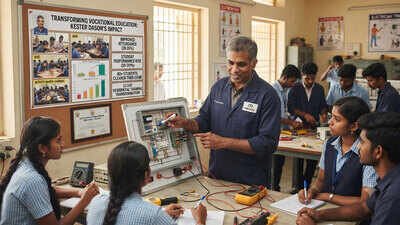







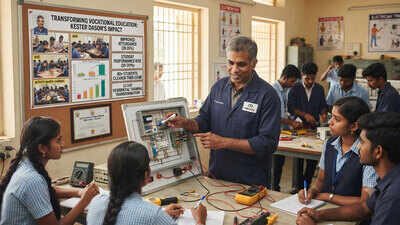
A student who struggles with a formula on the blackboard can sometimes become the most confident person in a practical workshop. For Kester Dason, who has spent nearly 27 years training students in industrial trades, this difference has been one of the defining features of his classroom.The challenge was never simply teaching students how to handle tools or complete a practical task. It was finding a way to make them participate in lessons that required them to sit, listen and understand theory. A training programme eventually changed how he approached that problem, and the results began showing up in his classroom.As reported by The Better India, Kester, an instructor at an Industrial Training Institute (ITI) in Tamil Nadu, began moving away from lecture-heavy teaching after attending a 12-day residential programme in August 2025. The change has since brought more participation into his lessons, with the instructor reporting improvements in attendance and student performance.
When practical confidence did not translate into classroom participation
Kester teaches wireman trainees, many of whom join ITI after completing Class 8. Some arrive with difficulty understanding formulas and basic arithmetic. Yet, when they enter the practical laboratory, their approach changes.They become more willing to experiment, handle equipment and attempt tasks independently. For Kester, the contrast raised a question: how could the same willingness to participate be brought into theory lessons?For years, his teaching relied largely on lectures, presentations and videos. These methods helped him explain technical concepts, but they did not always generate the same involvement he observed during practical sessions.The turning point came when he attended a training programme that introduced him to a different way of approaching vocational education. Instead of treating students as listeners throughout a lesson, the emphasis was on making them participants.
From lectures to activities: What changed after the training
The programme introduced Kester to interactive teaching methods, including icebreakers, quizzes through Kahoot and activity-based learning.After returning to his classroom, he began incorporating these methods into his lessons. Rather than starting directly with technical theory, he introduced activities that could help students become comfortable and more willing to participate.Kahoot, for instance, allowed students to answer questions on their mobile phones and see their performance immediately. This made revision more interactive and gave students an opportunity to test their understanding instead of simply following another presentation.The change also influenced how Kester approached students who were reluctant to participate. He realised that not everyone had the same confidence or command over language. Putting hesitant learners on the spot could make them withdraw rather than encourage them.He therefore began looking for ways to involve students without making classroom participation an uncomfortable experience.
Why improving trainers can change vocational education
The programme reflects a larger question facing India’s vocational education system: how can institutions improve the quality of training when instructors themselves need opportunities to update their teaching methods?An ITI instructor does more than demonstrate a technical procedure. Students must also understand the principles behind a task, learn to identify faults and develop the confidence to apply their knowledge in a workplace.The training programme combines teaching methodology with trade-specific technical learning and practical exposure. Its residential format typically runs for 12 days, beginning with sessions on interactive teaching and digital engagement before moving into technical training.The technical component includes both classroom instruction and hands-on sessions, with practical work accounting for a larger share of the training. Participants also learn how to plan lessons, deliver them and assess whether students have understood what was taught.The programme includes teaching exercises in which trainers conduct short lessons and receive feedback on their subject knowledge, communication, classroom engagement and ability to involve learners.The idea is to strengthen the person responsible for delivering vocational education, so that improvements in teaching can eventually reach a much larger number of students.
80 students who cleared a recruitment examination
For Kester, the most meaningful measure of teaching is what happens after students leave the classroom.He currently teaches around 40 trainees and has reported a 10-15% improvement in attendance and a 10-20% improvement in performance following the introduction of interactive methods.But another milestone from his teaching career gives a clearer picture of what he considers important. Around 80 of his former students cleared the written examination for recruitment to the Tamil Nadu Electricity Board and progressed to the practical selection stage.The achievement did not happen overnight. It reflects the longer process of helping students acquire technical knowledge and prepare to demonstrate their abilities in competitive recruitment.Over the years, some of his trainees have also pursued diploma courses and participated in state-level skill competitions. For Kester, these outcomes are closely connected to the purpose of vocational education: helping students convert what they learn into opportunities for employment.
The next classroom could have other instructors
Kester is now looking towards a training officer role, where he hopes to work with other instructors and share the teaching methods he has learnt.That ambition also brings his experience back to the original challenge. A change in one classroom can benefit a limited number of students, but when an instructor passes those methods to other trainers, the reach can extend further.After nearly 27 years in industrial training, Kester’s approach has evolved from relying primarily on lectures and demonstrations to creating more opportunities for students to participate, practise and learn through experience.The larger lesson from his journey is not that practical training can replace theory. It is that students need both, and the way theory is taught can determine how confidently they apply it.For the 80 students who progressed beyond the written recruitment examination, and for the trainees now learning in his classroom, that distinction could make a difference well beyond their time at ITI.