
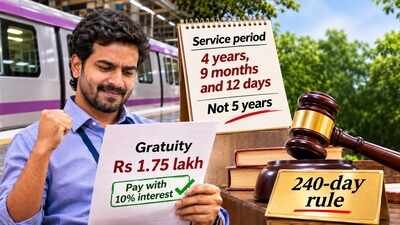








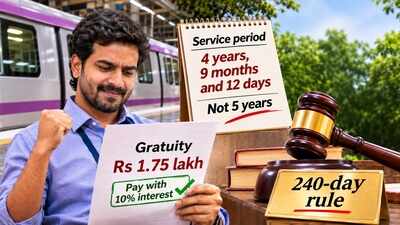
Are you entitled to a gratuity payout if you have not completed five years of continuous service with your employer? While the Labour codes have undergone a change and some rules have changed, certain pending cases also raise this important question.In one such case, the Karnataka High Court has ruled that an employee who leaves a job before completing five years of continuous service can still qualify for gratuity if the conditions laid down under the Payment of Gratuity Act, 1972, are met.The court held that where an employee has worked for at least 240 days during the 12 calendar months immediately preceding his resignation, the period can be treated as a complete year of service for determining gratuity eligibility.
What the case is about
The dispute involved a former assistant engineer at Bangalore Metro, whose claim for Rs 1.75 lakh in gratuity was rejected because his tenure fell short of five years.He had worked for four years, nine months and 12 days.The man joined the Bengaluru Metro Rail Corporation (BMRCL) as an assistant engineer on July 6, 2017. He resigned on March 19, 2022, and was formally relieved of his duties on April 18, 2022. His total period of employment amounted to four years, nine months and 12 days.After leaving the corporation, he made several representations seeking payment of gratuity. He claimed Rs 1.85 lakh, calculating the amount on the basis of his last-drawn monthly salary of Rs 64,210.BMRCL declined to release the payment, prompting him to approach the court.
Why the court ruled in favour of ex-employee
The Karnataka High Court observed that the dispute could not be decided simply by checking whether the man had completed five calendar years from the date he joined BMRCL.His entitlement to gratuity had to be assessed by reading Section 4(1) of the Payment of Gratuity Act alongside the definition of “continuous service” provided under Sections 2(c) and 2A.The bench also made it clear that gratuity is not a discretionary payment or a benefit granted by an employer as a matter of goodwill, an ET report said. It is a statutory entitlement that becomes payable when the employee fulfils the conditions prescribed under the law.Section 4(1) of the Payment of Gratuity Act lays down the requirement of five years of continuous service, subject to certain specified exceptions.However, the court said this provision cannot be considered on its own, without taking into account Section 2(c), which defines “continuous service” with reference to Section 2A.Section 2A, in turn, sets out the statutory criteria for determining whether an employee has completed continuous service. Under the circumstances specified in sub-section (2), an employee can be deemed to have completed the prescribed period of continuous service if he has worked for at least 240 days during the relevant 12-calendar-month period.The Karnataka High Court observed that the deeming provision is an integral part of the legal framework for determining continuous service, rather than a factor that can be disregarded.Consequently, an employee’s eligibility cannot be decided merely by counting the calendar time between the date of joining and the end of employment. The actual number of days worked and the applicability of Section 2A of the Payment of Gratuity Act must also be examined.Against this backdrop, the court identified the central issue in the man’s case as whether his employment during the fifth year met the statutory conditions and whether he could claim the benefit of the deeming provision on the basis of the facts placed before the statutory authorities.The Karnataka High Court ruled in favour of the engineer and directed Bangalore Metro to pay him Rs 1.75 lakh along with interest at 10% from May 18, 2022.Explaining the significance of the decision, Mayank Parashar, Legal Associate at Clasis Law-India, told ET: “Karnataka High Court has now re-settled the principle in the context of eligibility of the continuous service requirement for gratuity and concluded that employers should consider the definition of continuous service and key conditions for gratuity together. That’s said every employee who has completed 240 days in 6 days working and 190 days in 5 days working but has not completed the entire year should be considered eligible for gratuity.“