







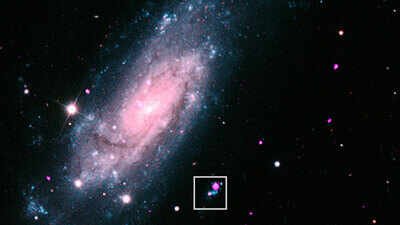


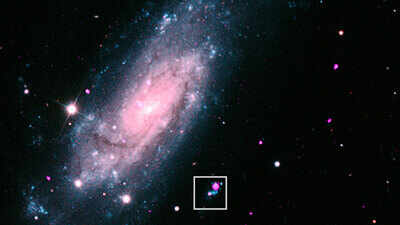
For years, astronomers watched a giant star in a distant galaxy do something that seemed almost impossible. It repeatedly brightened with the intensity of a stellar explosion, faded away and then did it all over again. Unlike a supernova, however, the star never disappeared.Now, NASA’s Chandra X-ray Observatory has helped uncover what may be driving this extraordinary behaviour. The answer lies in an object that remained hidden from view: a compact cosmic companion, either a black hole or a neutron star, locked in an orbit around the unstable star.The discovery, detailed in a new paper published in The Astrophysical Journal, offers a fresh explanation for one of astronomy’s more puzzling stellar phenomena.
A star that mimicked a supernova 27 times
The star, named AT 2016blu, is located in the spiral galaxy NGC 4559, approximately 30 million light-years from Earth. Astronomers estimate that it has a mass at least 33 times that of the Sun. It belongs to a class of extremely hot and massive stars known as luminous blue variables, which are notorious for dramatic changes in brightness.What makes AT 2016blu particularly unusual is the frequency and intensity of its eruptions. Between 2012 and 2026, researchers recorded at least 27 bursts of visible light, occurring roughly every 113 days. Each event looked remarkably similar to a supernova, the spectacular explosion associated with the death of a massive star.Yet AT 2016blu kept surviving.Astronomers call such events ‘supernova impostors’ because they imitate the brightness and appearance of genuine stellar explosions without destroying the star itself.“For 15 years, astronomers have been watching this star get really bright and then dim again on a regular basis,” said Mojgan Aghakhanloo of the University of Virginia, who led the study. The missing piece of the puzzle, she explained, was obtaining X-ray observations at precisely the right moment.
NASA’s Chandra telescope spots an invisible companion
That opportunity arrived in March 2026, when Chandra observed the system during an outburst. The telescope detected X-ray emission at least 100 times brighter than measurements recorded in 2001 and 2002, before the repeated eruptions began.The observations point towards an extraordinary interaction between the two objects. As the giant star and its compact companion move along an elongated orbit, they approach each other periodically. During these close encounters, the black hole or neutron star appears to capture material released by the massive star.That material spins around the compact object at tremendous speeds, heats up to extreme temperatures and produces powerful X-rays. The surrounding dense gas absorbs some of this energy and subsequently glows in visible light, creating the spectacular bursts observed by astronomers.
Why this discovery matters for astronomy
The finding is significant beyond solving the mystery of a single star. AT 2016blu is also a candidate ultra-luminous X-ray source, a rare category of exceptionally bright X-ray objects that scientists are still trying to understand.The discovery raises the possibility that some of these mysterious sources are connected to massive stars interacting with black holes or neutron stars.Equally important, the research could help astronomers understand why certain massive stars undergo dramatic changes shortly before ending their lives in supernova explosions.Behind this discovery was an extensive observing effort involving professional observatories and more than 30 amateur astronomers who helped track the star’s changing brightness.After 15 years of unexplained cosmic fireworks, AT 2016blu has offered astronomers a remarkable lesson: sometimes, the most spectacular activity in the universe is not caused by a star acting alone, but by the invisible companion orbiting beside it.