











MUMBAI: Corporate profits have recovered much faster than investment after the pandemic, with aggregate profit before interest and tax (PBIT) growing 21.4% in FY24 against 6.1% growth in gross fixed assets (GFA), an Economic Advisory Council to the Prime Minister working paper has found.Profitability itself has risen too. Median return on assets (ROA) in the study sample increased from 4.4% in FY21 to 7.2% in FY24.The contrast is therefore not between rising profits and falling investment. Corporate investment has also recovered after Covid, but at a considerably slower and less sustained pace. Gross fixed asset growth, which the paper uses as a proxy for fixed-asset investment, moved from a contraction of 1.1% in FY21 to growth of 2.2% in FY22, 6.8% in FY23 and 6.1% in FY24. Over the same three post-pandemic recovery years, PBIT grew 15.2%, 12.8% and 21.4%.One explanation identified by the study is that strong profitability from assets companies already own does not necessarily make a new investment equally attractive. Its analysis found evidence that the initial returns associated with fresh fixed-asset investment have weakened in the post-pandemic period, putting downward pressure on what the paper calls “marginal profitability”.
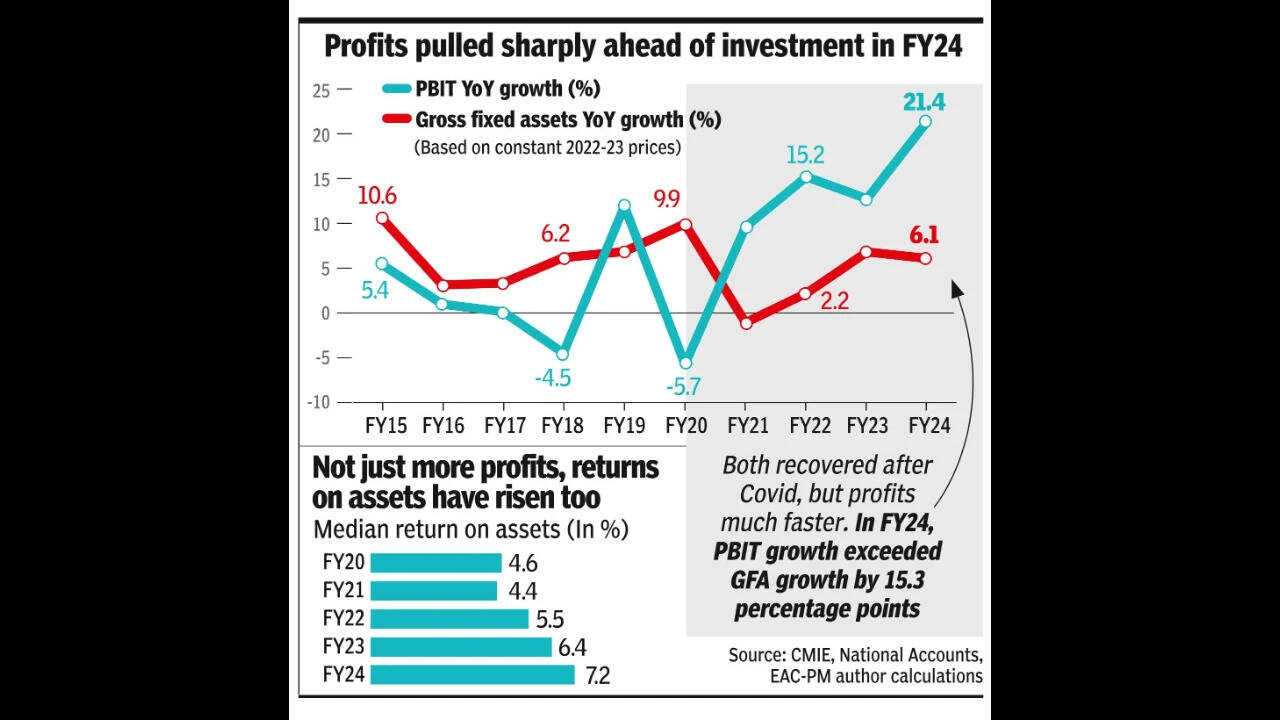
Median return on assets (ROA) in the study sample increased from 4.4% in FY21 to 7.2% in FY24.
In other words, a company can be earning strongly from its existing plant and machinery but still hold back on adding another plant if it expects the additional investment to deliver lower returns.The paper said global economic uncertainty, trade imbalances and the possibility of rapid technological change making existing technologies obsolete could also be weighing on investment decisions, although it did not separately test the impact of demand or uncertainty. It found no evidence that greater market concentration or financial constraints were important explanations for the gap between profitability and investment. Nor did it find a broad shift of companies towards asset-light business models.Instead, manufacturing companies appear to be generating more revenue from their existing fixed assets, pointing to improved capacity utilisation. The paper said this was a positive development that could eventually create conditions for another round of investment.Investment recovery also differed by ownership. Foreign-owned firms showed a continuing decline in weighted average investment intensity after the FY20 peak, while the recovery among Indian private firms levelled off after an initial improvement. Companies belonging to Indian business groups showed a more sustained recovery.The paper also found that the investment peak in FY20 was partly driven by unusually high investment intensity among some large, asset-rich companies. Such an outlier spike disappeared during the pandemic and had not returned by FY24, helping explain why the subsequent investment recovery has been more muted. The study used CMIE Prowess financial data for 48,896 companies, including 5,614 listed and 43,282 unlisted firms.
Share your thoughts in the comments
Be respectful · TOI community guidelines
FY25 data was excluded from most of the quantitative analysis because corporate filings and the database for the year were largely incomplete.Based on its findings, the paper recommended continuing and intensifying production-linked incentive schemes and public infrastructure investment aimed at crowding in private investment. It also called for greater support for innovative firms, stronger links between industry and academia, and faster contract enforcement and commercial dispute resolution.