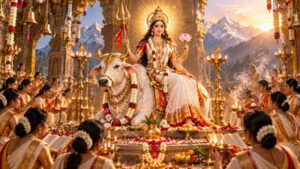







Shaila means mountain, and putri means daughter. The first goddess of Navratri carries that name like an address. She comes from the Himalayas. On Sunday, 11 October 2026, Pratipada, the first lunar day of Ashvin Shukla, marks the beginning of her worship as the Kalash is installed in homes across the country. Ghatasthapana, the installation of the Kalash, is performed in the early morning, roughly between 6:19 AM and 10:12 AM in Delhi (check your local panchang for accurate timings). This year, Navratri runs for ten days. The sequence of nine goddesses begins with the one who does not move.Why start with a mountain? Because every beginning needs steadiness. A fast is not only about nine or ten days; it is about building a resolve that holds firm when the mind grows restless. Many devotees regard Shailputri as the foundation of the nine goddesses, the steady base upon which the other eight forms are understood to build.
Sati, Daksha, and the yajna Shiva told her to skip
To understand Shailputri, begin with her earlier birth. According to Puranic accounts, which differ in detail from one text to another, Shiva was married to Sati, the daughter of Daksha Prajapati. Daksha disapproved of his son-in-law. Shiva owned little, lived simply, and remained absorbed in meditation.When Daksha organised a grand yajna, a fire ritual, he invited the gods but deliberately excluded Shiva. Sati wanted to attend anyway. Shiva warned her against going somewhere she had not been invited. She went regardless. At the yajna, she witnessed her husband being insulted publicly. Overwhelmed by shame and grief, she gave up her life there.Shiva’s warning is clear in the story, as is the force of emotion that overrode it. The tale does not condemn devotion. Instead, it shows how quickly a loyal heart can walk into a fire it has been warned to avoid.
A name associated with joy, and a memory that survived
Sati was reborn as Parvati, the daughter of Himavan, the king of the Himalayas. The name Parvati is associated with the mountains, while her story is closely linked to joy, renewal, and devotion. Born in the mountains, she retained the memory of her previous life and her devotion to Shiva, resolving to win him as her husband once again.This rebirth is not presented as a casual second chance. It represents continuity of devotion and purpose. The scene shifts from a yajna marked by insult and grief to the immovable Himalayas, yet the centre remains the same: Shiva, remembered and chosen again.
The bull, the mountain, and the root of the spine
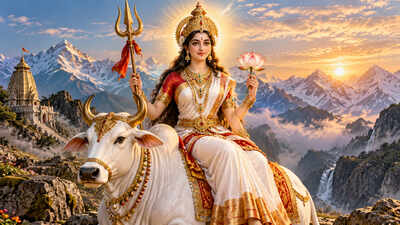
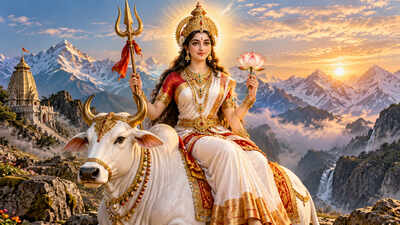
Shailputri’s iconography draws on two powerful symbols of stability. In Indian tradition, the bull represents strength and steadiness, while the mountain is among the most enduring symbols of immovability. Shailputri is the daughter of the mountain and rides a bull. Both symbols underscore her unwavering resolve to unite with Shiva. Philosophically, her quest is interpreted as the individual soul seeking union with the Supreme, with Shiva representing that ultimate goal.In certain Tantric and yogic traditions, Shailputri is associated with the Muladhara Chakra, or root chakra, located at the base of the spine and linked to grounding and stability. This is why the first day of Navratri is often described as an opportunity to place your feet on solid ground. This association comes from yogic practice and later devotional interpretations rather than from a single, universally accepted scriptural rule.Navratri means “nine nights,” and many devotees interpret these nights as nine stages of spiritual progress. Autumn has settled in after the monsoon, and before the journey continues, one goddess asks only that you stand still long enough to find your footing.A mountain does not argue, rush, or leave. Whatever you vow this morning, ask yourself whether you could remain true to it on the tenth day.