








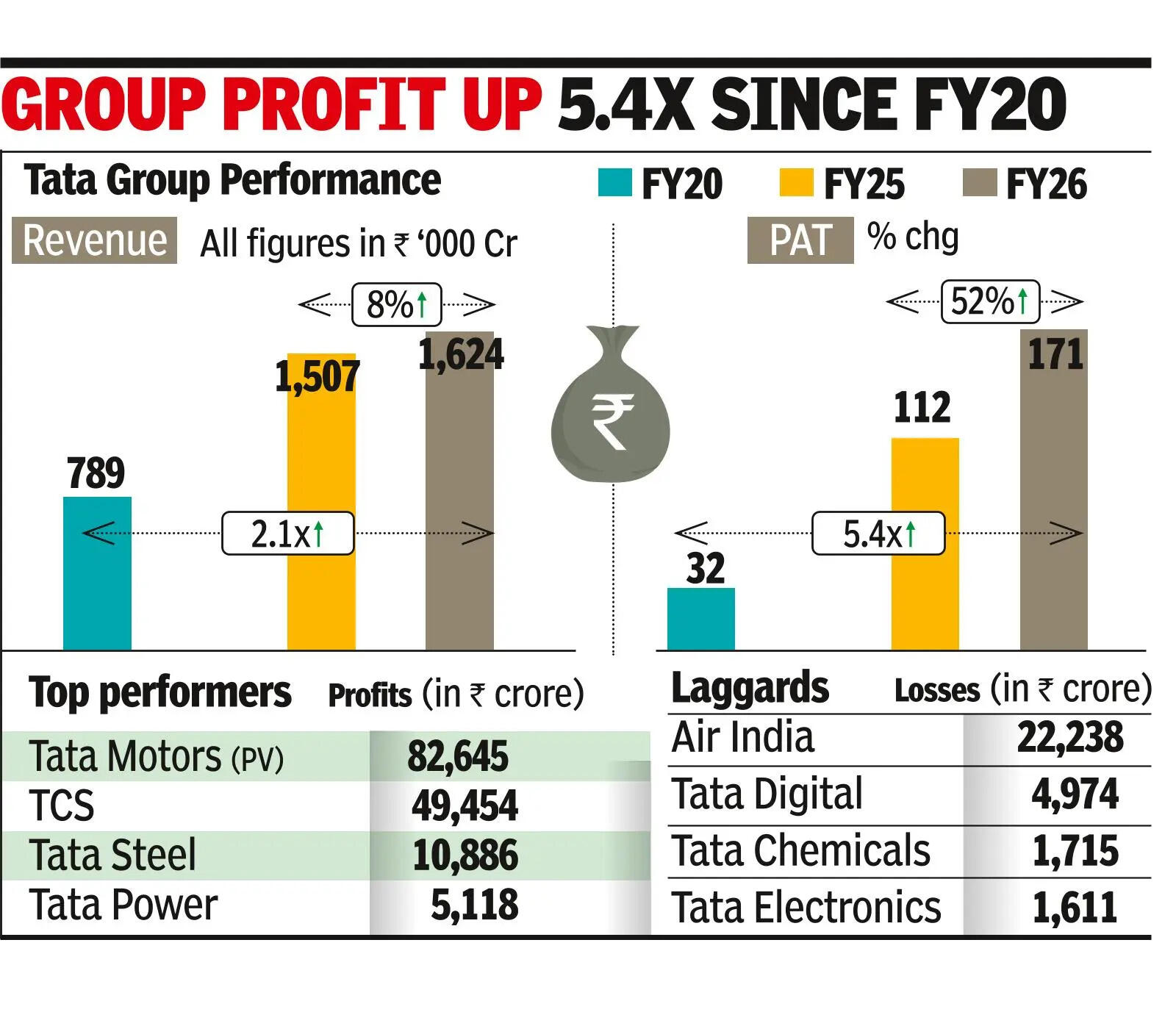
MUMBAI: Tata Sons posted a 22% jump in profit in FY26, lifted by gains from the listing of Tata Capital, even as its chairman N Chandrasekaran faces a crucial annual general meeting over his future at the conglomerate.Net profit at the holding company of the salt-to-software group rose to Rs 31,961 crore from Rs 26,232 crore in FY25, largely driven by Rs 6,531 crore in gains from sale of investments — against a negligible Rs 72 crore a year earlier, as Tata Capital’s IPO, India’s fourth largest, delivered a windfall.Revenue rose 9% to Rs 42,367 crore. Dividend income, Tata Sons’ core recurring revenue source, fell 10% to Rs 32,528 crore, mainly because of a lower payout from TCS, the group’s crown jewel. Brand royalty income, charged to group companies for use of the Tata name, rose 23% to Rs 2,294 crore.The results translated into a modest rise in Chandrasekaran’s annual pay to Rs 159 crore from Rs 156 crore in FY25, even as Noel Tata, chairman of promoter Tata Trusts, raised concerns about losses at some of the group’s newer businesses.The board declared a dividend of Rs 1.10 lakh per share, up 70% from Rs 64,900 a year earlier. Sir Dorabji Tata Trust and Sir Ratan Tata Trust will receive Rs 1,252 crore and Rs 1,054 crore respectively, while Noel, who owns 4,060 Tata Sons shares, will receive Rs 45 crore.The AGM, called for August 18, will seek shareholders’ vote on Chandrasekaran’s reappointment as a director, who retires by rotation at the meeting. Retaining his board seat is essential for him to continue as chairman until his term expires in February 2027.The AGM itself faces a potential hurdle. Tata Sons’ articles require a jointly nominated representative of SDTT and SRTT to be present for a quorum — a condition that has become difficult to satisfy after the Maharashtra charity commissioner barred SRTT from holding board meetings.The company reiterated that its application to surrender its investment company licence to the RBI, submitted in FY24 to avoid mandatory listing requirements, remains under consideration. Noel has opposed listing Tata Sons as it would dilute Trusts’ control.At the group level, net profit rose 52% to Rs 1.7 lakh crore, while revenue climbed 8% to Rs 16.24 lakh crore. Yet losses at several new businesses continued to weigh. Air India posted a loss of Rs 22,238 crore, more than double the previous year. Tata Digital, which has drawn particular scrutiny from Noel, saw losses widen to Rs 4,974 crore from Rs 4,610 crore. Tata Electronics’ loss ballooned to Rs 1,611 crore from Rs 70 crore, while Agratas reported a loss of Rs 1,101 crore, up from Rs 741 crore.
At Rs 1.1 lakh per share, Holdco’s dividend up 70% from FY25
The figures underscore a familiar pattern within the Tata Group: profits from mature, cash-generating businesses such as TCS continue to fund capital-intensive investments in aviation, semiconductors and battery manufacturing that are still in early, negative-return phases.Chandrasekaran defended the group’s investments in semiconductors, e-commerce, telecom equipment, aviation, energy transition and defence manufacturing as long-term bets. “These are institutions we are seeding now with long gestation periods,” he said, adding that the Tata Group measures success not only by near-term financial performance but also by its ability to create “generational impact.”Chandrasekaran called FY26 Air India’s most challenging year, citing airspace closures, higher fuel prices following the West Asia conflict and the AI171 crash. He said the airline’s turnaround should be viewed as a “five- to ten-year journey”, requiring fleet renewal, training, service improvements, network expansion and an overhaul of legacy systems and culture. “Every great airline in history was built over decades, not quarters,” he said.On Tata Digital, Chandrasekaran said the business has navigated “multiple complexities” in recent years as India’s e-commerce market shifted rapidly towards quick commerce. BigBasket is adapting to the change, while Tata Neu is targeting a 10x increase in payments users and expanding into lending and insurance. Despite continued losses, Tata Digital is beginning to show progress. “We have made a decisive shift — refocusing Tata Neu on financial services and loyalty.”On Tata Electronics, Chandrasekaran is bullish: operating profits have already achieved breakeven. “Chips are the new steel,” he said. “Every phone, car, aircraft, hospital, power grid, and AI system runs on them.” The group that built its name on salt and steel is now staking its future on silicon and sustainability.