










NEW DELHI: “Understand before you invest.” Many must have received a message from the Securities and Exchange Board of India (Sebi) through its awareness initiative, “Samajh Se Investing Simple”.But how much do you really need to know about money and investment? This is where financial literacy comes in. And of course, it goes well beyond knowing how to buy shares or start a systematic investment plan (SIP). It involves understanding where your money goes, how borrowing works, what risks investments carry, how inflation affects savings and why taxes matter.Financial literacy is a “combination of financial awareness, knowledge, skills, attitude and behaviour necessary to make sound financial decisions and ultimately achieve individual financial well being,” as defined by the organisation for economic co-operation and development (OECD), an international organisation that works with governments to develop policies for better economic and social outcomes.And as India’s investor base expands, an important question emerges: Are more people becoming financially literate, or are they simply gaining easier access to financial products? Or just following the hype and the crowd?According to the Association of Mutual Funds in India (AMFI), the mutual fund industry had 28.62 crore folios as of September 30, 2026, while assets under management stood at Rs 82.64 lakh crore. Participation in the stock market has also expanded rapidly. The National Stock Exchange (NSE) reported more than 25 crore registered client accounts as of February 2026, with its unique registered investor base crossing 13 crore in April 2026. Meanwhile, the Bombay Stock Exchange (BSE) added 3.53 crore investor accounts in FY26, taking its total beyond 25 crore.The shift is also visible in how households allocate their savings. The Economic Survey 2025-26 showed a gradual shift towards equity and investment funds in the composition of household financial assets from FY19 to FY25.The gap between participation and understanding becomes more apparent when investors’ knowledge is examined. The Sebi Investor Survey 2025 found that only 36 per cent of investors had high or moderate knowledge of the securities market. The assessment tested respondents’ familiarity with stock markets and their understanding of how inflation affects purchasing power. The findings raise an important question: as more Indians enter financial markets, are they equipped to understand the products they buy and the risks they take?So, how financially literate are you? There is no formal set of rules to define it, but here are 10 questions that can help determine it with expert insights.
1. Do you know where your money goes every month?
Financial literacy begins with understanding your income, expenses and savings. Can you identify how much you spend on essentials, discretionary purchases and debt repayments? Do you know how much remains for emergencies and future goals?A budget need not be complicated. Even a monthly record of earnings and expenses can help identify unnecessary spending.
2. Do you understand inflation and compounding?
Suppose you have Rs 1 lakh today. If inflation averages 5 per cent annually, something costing Rs 1 lakh today would cost approximately Rs 1.63 lakh after 10 years.That is why keeping money aside is not always enough. You must also consider whether your savings and investments can preserve purchasing power.Compounding, meanwhile, allows returns to generate further returns over time. But the same principle can work against borrowers when unpaid interest accumulates.Understanding both concepts helps explain why starting early, staying consistent, and managing debt are important.In this regard, Aswini Bajaj, CEO of Leveraged Growth, cautioned against blindly following popular savings formulas. “Understanding the fundamentals is important, but knowing how to apply them to your own life matters just as much. The goal is to make informed financial decisions based on your needs and circumstances, rather than blindly following thumb rules or someone else’s advice.”Further encouraging people to understand finance better, he added, “Whether you’re earning your first salary, starting to invest or feeling the pressure to match a lifestyle you see on social media, ask yourself: What am I saving or investing for?” He further stressed that the focus should be on using money to achieve personal goals and build financial security, rather than chasing returns or following trends without assessing their suitability.
3. Can you distinguish between saving and investing?
Saving generally involves setting money aside for immediate needs, emergencies or short-term goals. Investing involves committing money to assets with the expectation of generating returns, usually while accepting some degree of risk.As CA Balvinder Singh Oberoi stressed, earning more is not enough; what matters is how well people save and make their money work for them. “Buying and selling shares on any app doesn’t make anyone literate,” he said, emphasising that investments must be aligned with financial goals rather than treated as an end in themselves.Oberoi also highlighted the gap between knowing the importance of saving and actually practising it, pointing to lifestyle inflation, the desire for instant gratification and intimidating financial jargon as barriers to financial discipline.Ultimately, financial literacy means understanding your assets and liabilities, knowing when and where to deploy your money, and making financial decisions that support your goals and long-term wealth creation.
4. Do you understand risk before investing?
Every investment carries risks, although their nature and extent differ.Stocks can fluctuate sharply, mutual funds are subject to market risks, and even relatively stable products can carry inflation, liquidity or other risks.Before investing, ask whether you understand the product, its potential losses, charges and suitability for your financial goals.Leveraged Growth CEO Bajaj thus made an important distinction between the ability to bear losses and the emotional willingness to accept them. “Being able to afford risk and being comfortable with it are two different things.”Financial literacy means recognising both, rather than selecting investments solely because they promise higher returns.
5. Do you understand how loans and credit cards work?
Borrowing is not necessarily bad financial management. Home loans, education loans and business credit can serve important purposes.However, borrowers should understand interest rates, repayment schedules, processing fees, penalties and the total cost of borrowing.For example, a loan advertised at a relatively low monthly interest rate may be considerably more expensive when expressed as an annual rate.Similarly, paying only the minimum amount due on a credit card does not eliminate the remaining debt. Interest and other applicable charges can continue accumulating.Understanding these obligations helps prevent manageable borrowing from becoming a financial burden.
6. Do you have an emergency fund and adequate insurance?
Financial planning is not just about growing money. It is also about protecting yourself from unexpected expenses.An emergency fund helps cover essential expenses during job loss, medical emergencies or other financial disruptions. A commonly used starting point is three to six months of essential expenses, although the appropriate amount depends on income stability and family responsibilities.Insurance serves a different purpose. Health insurance can reduce the financial impact of medical expenses, while life insurance can provide financial protection to dependants.Understanding what a policy covers, its exclusions, premiums and claim conditions is as important as purchasing it.
7. Do you understand how your income and investments are taxed?
Knowing your salary is one thing. Understanding how much of it is taxable is another.CA Chandni Anandan, tax expert at ClearTax, said basic tax literacy means understanding taxable income, deductions, exemptions, tax deducted at source (TDS) and the differences between the old and new income tax regimes.“Tax literacy does not mean knowing every section of the law. At a basic level, an individual should understand how their income is taxed, what makes up taxable income, which deductions or exemptions may apply to them, and how taxes already deducted through TDS affect their final liability.”For investors, it also means knowing that short-term and long-term capital gains may be taxed differently, depending on the asset and applicable rules.Anandan further cautioned against assuming that tax deducted by an employer or bank settles the entire liability. Individuals should also review their Annual Information Statement (AIS), Form 26AS and income tax returns.Simply filing a return, even accurately, does not necessarily demonstrate an understanding of taxation.
8. Can you recognise financial fraud and misleading investment advice?
A message promising unusually high returns with little or no risk should raise questions, not excitement.Financial literacy involves recognising warning signs such as guaranteed returns, pressure to invest immediately, unsolicited stock tips and requests for sensitive banking information.It also means checking whether an investment intermediary is appropriately registered and understanding the product before transferring money.Here, Anooshka Soham Bathwal, CEO and founder of Dhanvesttor, warned that investors can be misled when they focus on a product’s apparent benefits without assessing its suitability. She noted that people often follow recommendations from friends, agents or social media without understanding the associated risks, potential returns, costs or tax implications.“People may only pay attention to its benefits in terms of savings and ignore factors related to their suitability and needs,” she said, while shedding light on investors and their tendency to prioritise tax savings over overall financial well-being.Bathwal also highlighted the gender divide when it comes to financial decisions, observing that some women with substantial earnings still leave financial decisions to male relatives or consultants.“Financial independence is not just about earning money; it’s also about having the knowledge and confidence to decide what to do with it.”Her advice is to look beyond the promised benefit, understand the product and assess whether it fits one’s financial goals and risk capacity before investing.
9. Do you have a financial plan for the future?
Financial goals change with age and circumstances. A first-time employee may prioritise an emergency fund, while someone approaching retirement may focus on income security.The important thing is to identify goals, estimate their costs and select appropriate saving or investment options.Retirement planning also requires understanding how inflation can increase future living expenses and how pension or retirement savings products work.Dr Shunil Tripathi, a financial literacy activist and trainer associated with financial education programmes of the RBI, Sebi, IRDAI and PFRDA,said a financially literate person connects savings and investments to specific goals and time frames rather than following market trends.The objective is not necessarily to maximise returns at every opportunity, but to make financial decisions that support long-term security.
10. Can you make financial decisions independently?
Perhaps the most important test of financial literacy is whether you can explain your financial choices.Do you understand why you hold a particular investment? Can you assess a loan offer without relying entirely on a salesperson? Would you question a financial recommendation that does not match your circumstances?Being financially literate does not mean never seeking professional advice. It means knowing enough to ask relevant questions and evaluate the answers.As financial programme trainer Dr Tripathi further said, “Someone who invests has taken an action. Someone who is financially literate understands why they took it.”It also means recognising that financial decisions should not be entirely outsourced to family members or advisers.
The bigger picture
Financial literacy does not mean knowing every investment scheme, tax provision or market mechanism. It means understanding the basics well enough to make informed decisions, recognise risks and ask the right questions.
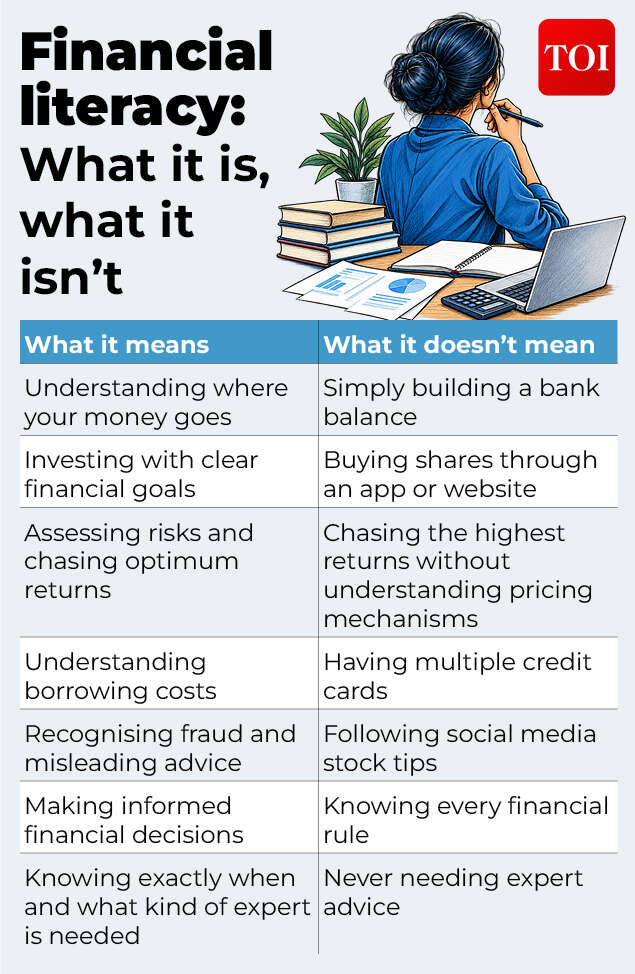
What financial literacy means- some thumb rules
Also, the above 10 questions are not a formal test or a set of established rules to measure financial literacy. They are a starting point to help one reflect on their financial habits, identify gaps in understanding and take a more active interest in managing money.You do not have to become a financial expert overnight, nor does being financially literate mean managing everything on your own. The aim is to take an active interest in your finances, understand the decisions being made on your behalf and know when to seek professional advice. Experts can help you navigate complexity, but understanding your money remains your responsibility.